

Surprising fact to start: a single unchecked approval or a blind-signed swap instruction can convert a six‑figure DeFi position into an empty wallet faster than you can open a support ticket. For technically literate U.S. DeFi users the problem isn’t ignorance but ambiguity — transactions look simple on the surface, yet the wallet, the dApp and the smart contract all mediate invisible state changes and permissions. Transaction simulation is the tool that collapses that ambiguity into actionable facts before you hit confirm.
In this explainer I focus on how simulation fits into a multi‑chain, non‑custodial workflow aimed at reducing operational risk. I use the Rabby Wallet as the running example because it pairs a broad multi‑chain surface (90+ EVM chains) with explicit pre‑transaction simulation, pre‑sign risk scanning, approval management and hardware wallet integrations — features that change how a power user should think about safety, trade-offs and process design.
Mechanics: what transaction simulation actually does
At its simplest, simulation executes a prospective transaction against a local or remote node’s view of the chain state, without broadcasting it. That execution produces concrete outputs: estimated token balance deltas, gas consumed, emitted events, and whether the call would revert. This is not a fuzzy heuristic — it is a deterministic, state‑level dry run against the blockchain’s current snapshot. The key operational difference from a regular confirmation screen is that simulation reveals side effects that a contract call may cause beyond the immediate transfer value: nested contract calls, allowance adjustments, token swaps routed across pools, and liquidation triggers.
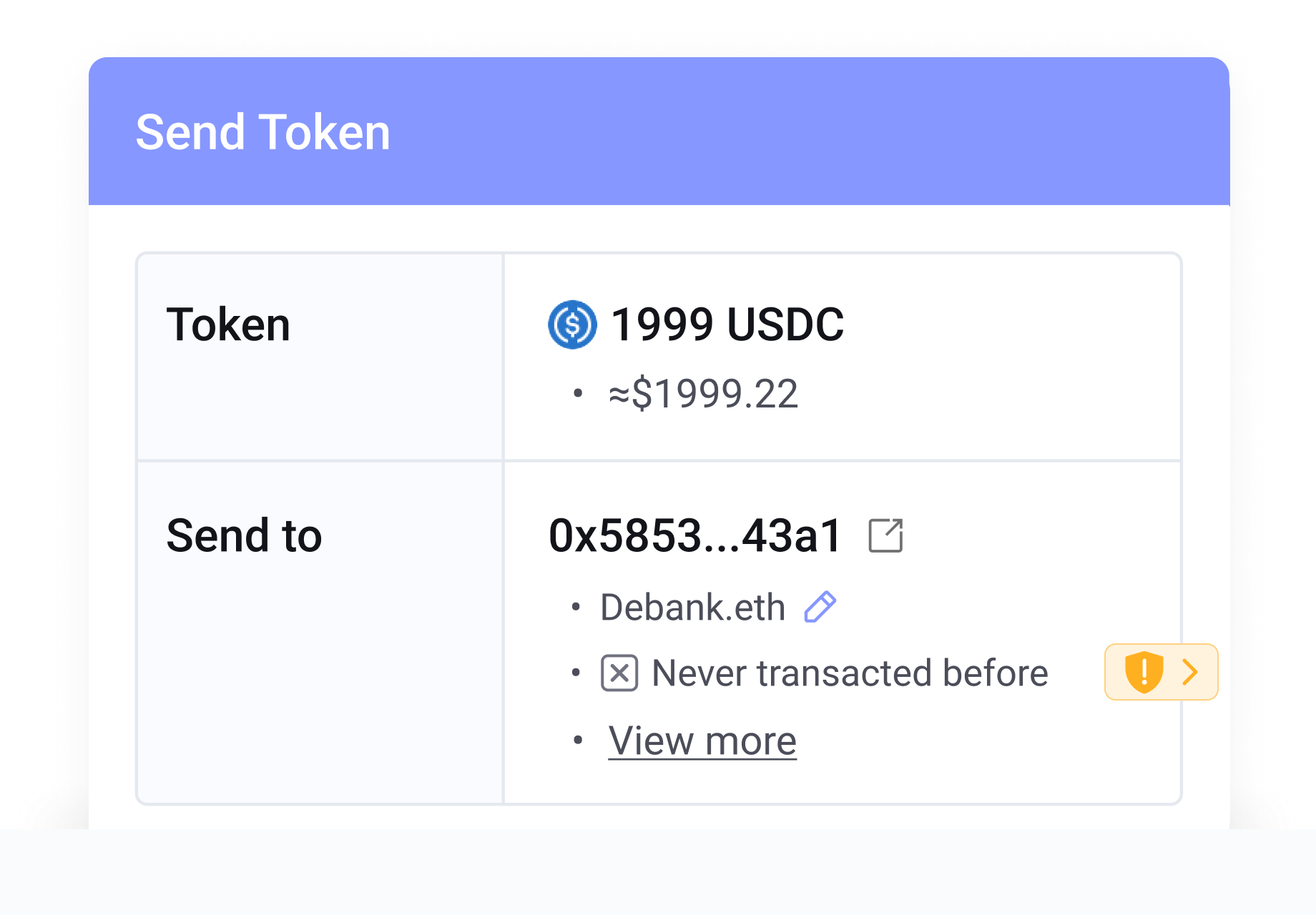
Rabby surfaces those results at the point of signing, showing the estimated token changes and fee costs and flagging suspicious patterns (for example, approval requests for unlimited allowances, interactions with contracts that were previously implicated in hacks, or non‑existent recipient addresses). This step addresses the familiar danger of „blind signing“ — when users confirm opaque payloads because the raw data on the confirmation box is uninterpretable.
Why this matters to DeFi power users
There are three concrete mechanisms by which simulation reduces risk for high‑value users: detection of unexpected balance changes, detection of silently escalated allowances, and verification that the gas estimate and routing behavior fit expectations. Consider a swap from Token A to Token B that looks like it will return X tokens. A simulation may reveal a different outcome because of slippage across multiple pools, front‑running, or an exploitable path inserted by a malicious router. Seeing the delta before signing lets a user either cancel or adjust parameters — not after the transaction has gone on chain.
Rabby adds value because it bundles simulation with an approval revocation tool and policy signals from a risk engine. For individuals and teams that also use multi‑sig or enterprise custody (Gnosis Safe, Fireblocks, Amber), Rabby’s integration points enable a safer signing workflow: simulate locally, then route to the multisig for co‑signing. For power users in the U.S., where regulatory attention and on‑chain compliance tools are increasing, keeping a clear audit trail and avoiding avoidable approvals matters not just for security but for operational governance.
What it doesn’t solve: limits and trade‑offs
Simulation is powerful but not omnipotent. First, simulations reflect the node’s state at the moment of the dry run; they cannot fully predict the race conditions that occur between simulation and final mining (MEV, frontrunning, mempool reorgs). Second, simulations depend on accurate ABI and RPC responses; a dApp that intentionally obfuscates calls or a node returning stale state can produce false negatives or positives. Third, some attacks operate off‑chain (social engineering, phishing, malicious browser extensions) and will still succeed if a user is tricked into approving a legitimate, but compromised contract.
There is also a usability trade‑off. Showing too many low‑level warnings increases alert fatigue. High‑frequency traders and bot operators may prefer minimal friction and will view simulations as latency; for them, streamlined signing plus off‑chain risk monitoring may be a better fit. Rabby attempts a middle path by focusing alerts on high‑impact anomalies (previously hacked contracts, unlimited approvals, non‑existent recipient addresses) and offering a “Flip” option for users who want to revert to MetaMask for compatibility reasons.
Comparative frame: how Rabby differs from alternatives
MetaMask, Trust Wallet, and Coinbase Wallet are all capable and widely used, but their baseline design choices emphasize general-purpose usability over explicit, transaction‑level safety engineering. Rabby differentiates by combining three features rarely bundled in consumer wallets: deterministic transaction simulation visible to the user, automatic network switching to prevent chain‑mismatch errors, and a built‑in approval revocation UI. Each piece contributes differently: automatic switching reduces simple user errors (e.g., attempting an Arbitrum swap while on Ethereum mainnet), while revocation reduces persistent attack surface created by forgotten allowances.
Open‑source architecture and hardware wallet support (Ledger, Trezor, Keystone and others) further lower systemic risk by enabling third‑party audits and air‑gapped signer workflows. But openness doesn’t equal perfect security: Rabby’s history includes a 2022 smart contract exploit associated with Rabby Swap that cost around $190,000. The team’s remediation — freezing the contract, compensating users and enhancing audits — demonstrates responsible incident response, but it also highlights that simulation and client‑side checks are only one layer among many in an overall security posture.
Decision heuristics: when to rely on simulation and when to add more defenses
Here are pragmatic heuristics you can apply right away:
– For novel contracts, always require a simulation and inspect token deltas and approvals. If the simulation shows an approval greater than you expect, revoke the approval immediately after the transaction or set a smaller allowance when possible.
– For large trades or rebalances, simulate and then delay signing by a short window (30–60 seconds) if network congestion is low; that gives you time to reassess if mempool conditions change. For very large positions, prefer multi‑sig flows where simulation forms the precondition for co‑signers.
– Use hardware wallets for high‑value accounts and make sure your extension connects to the hardware signer; Rabby supports multiple hardware devices and can simulate while the final signature is produced on the hardware device, preserving both transparency and private key security.
Near‑term watch list: what will change the value of simulation
Three developments will determine whether transaction simulation remains a decisive safety feature or becomes a checkbox that projects game theory around it. First, improvements in mempool privacy and decentralized transaction ordering (mempool encryption, private relays) can reduce the simulation-to-execution race, increasing simulation reliability. Second, wider on‑chain adoption of more expressive standards for allowance granularity would make simulations more precise about future risk. Third, regulatory pressure in the U.S. could push custodial and custodially‑adjacent services to demand stronger client‑side proof of pre‑transaction checks as part of compliance workflows.
All of these are conditional. If mempool privacy matures, simulation will look even better; if attackers shift to social engineering and off‑chain compromise vectors, the relative benefit of simulation will fall unless combined with better endpoint security.
FAQ
How reliable are simulation results at preventing losses?
Simulations reliably reveal deterministic outcomes given the current chain state and contract code. They prevent many classes of loss caused by blind approvals, unexpected allowance changes, or mispriced multi‑hop swaps. However, they cannot eliminate losses from frontrunning, MEV, or off‑chain compromises that change state between simulation and inclusion in a block. Use simulation as an important preventative control, not a sole guarantor.
Can simulation replace a hardware wallet or multisig setup?
No. Simulation complements but does not replace key‑management controls. Hardware wallets protect private keys from endpoint compromise; multisigs distribute signing authority to reduce single‑point failures. For high‑value or institutional accounts, combine simulation, hardware signing, and multisig policies to achieve layered defense.
Does Rabby support all blockchains for simulation?
Rabby supports simulation across a large set of EVM‑compatible networks (90+ chains) including Ethereum, BNB Chain, Arbitrum, Optimism, Polygon and Avalanche. The accuracy of a simulation depends on the node and RPC endpoint used for that chain; uncommon or custom chains with different execution semantics may produce less reliable simulations.
Is there any privacy exposure when using transaction simulation?
Simulation itself is a read‑only execution, but the request to simulate often touches RPC endpoints and can reveal intent patterns to the node operator or third parties if you use a public RPC. For privacy‑sensitive flows, prefer private RPCs or run a local node so your simulations do not leak precise trade intentions.
Practical takeaway: treat transaction simulation as a decision filter. It makes opaque contract effects legible, shrinks the attack surface caused by forgotten approvals, and integrates well with hardware wallets and multi‑sig custody. But it is not a silver bullet — pair it with careful key management, revocation hygiene, and an awareness of mempool dynamics. If you want to evaluate a wallet that foregrounds these protections and ties them into multi‑chain workflows, consider testing rabby wallet in a staged, low‑risk environment first: simulate, inspect, revoke, then scale up.


